
More Crypto Companies Are Going Public
Three crypto companies show how going public is bringing crypto and traditional finance closer together.
Crypto companies are increasingly going public, which means their shares can be bought and sold by anyone on public stock exchanges like Nasdaq. Each new listing is a sign that crypto and traditional finance are growing closer. Evernorth and EasyA are two recent examples, and Bullish (public since 2025) shows where that path can lead.
How Evernorth went public on Nasdaq
In October, Evernorth debuted on Nasdaq as a public company under the ticker XRPN. Evernorth is a digital asset treasury company, a public company that holds crypto as a core part of its business. In Evernorth’s case, that crypto is XRP. If the idea is new to you, our podcast episode on digital asset treasuries (DATs) with Evernorth’s CEO walks through how these companies work.
Evernorth went public by merging with a special purpose acquisition company (SPAC), a company that is already listed on a stock exchange and is created to combine with a private company and bring it to the public market. Two days after its debut, Evernorth rang the Nasdaq closing bell, a tradition that marks a company’s arrival on the exchange.
XRPN shares represent ownership in Evernorth (the company) and are a separate asset from XRP itself, so buying XRPN shares is not the same as buying XRP.

Evernorth rang the Nasdaq closing bell on October 14, 2026
EasyA’s proposed direct listing
While Evernorth has already made its debut, EasyA is earlier in the process, and it’s a different kind of crypto-industry company. EasyA describes itself as the engine powering leading blockchain and AI companies, helping developers learn to build with blockchain technology through its app, educational programs, and hackathons. You can hear more about its work with developers in our podcast episode.
In September, EasyA confidentially submitted a draft registration statement to the SEC for a proposed direct listing of its shares. A registration statement is the paperwork a company files before it can list publicly, and submitting it confidentially means the SEC reviews it privately before it’s made public. EasyA also recently completed an independent audit to Public Company Accounting Oversight Board (PCAOB) standards, the strict auditing standards used for U.S. public companies.
What’s the difference between an IPO and a direct listing:
In a traditional initial public offering (IPO), a company creates new shares and sells them to the public for the first time, usually with help from banks. The money from those sales goes to the company to help it grow.
In a direct listing, the company doesn’t create or sell new shares. Instead, shares that are already owned by people like the company’s founders, employees, and early investors become available to buy and sell on a public stock exchange.
EasyA plans to go public through a direct listing, not an IPO. The listing is expected to happen once the SEC finishes its review, as long as market conditions allow. If it moves forward, EasyA will become another crypto-industry company in public markets.

EasyA co-founders Phil and Dom Kwok
Settling an IPO with Stablecoins
Evernorth just made its public debut, and EasyA is still working toward one. Bullish, a crypto exchange that’s been public for more than a year, shows what can come next.
Bullish went public on the New York Stock Exchange (NYSE) in 2025 through a traditional IPO, raising more than $1.1 billion. It received its proceeds digitally in stablecoins, which Bullish highlighted as a historic step for U.S. IPOs.
After going public, Bullish brought its own stock onto the blockchain through tokenization. Earlier this year, it became the first public company on the NYSE to make all of its shares available as digital tokens, and in August 2026, a year after its IPO, Bullish’s tokenized shares began trading on its Gibraltar-regulated exchange, available to eligible customers outside the U.S. Others are now looking to bring tokenized stocks to the U.S.: in October, OKX and NYSE parent Intercontinental Exchange notified the SEC of plans for a venue that would trade tokenized versions of more than 60 U.S.-listed companies’ stocks.
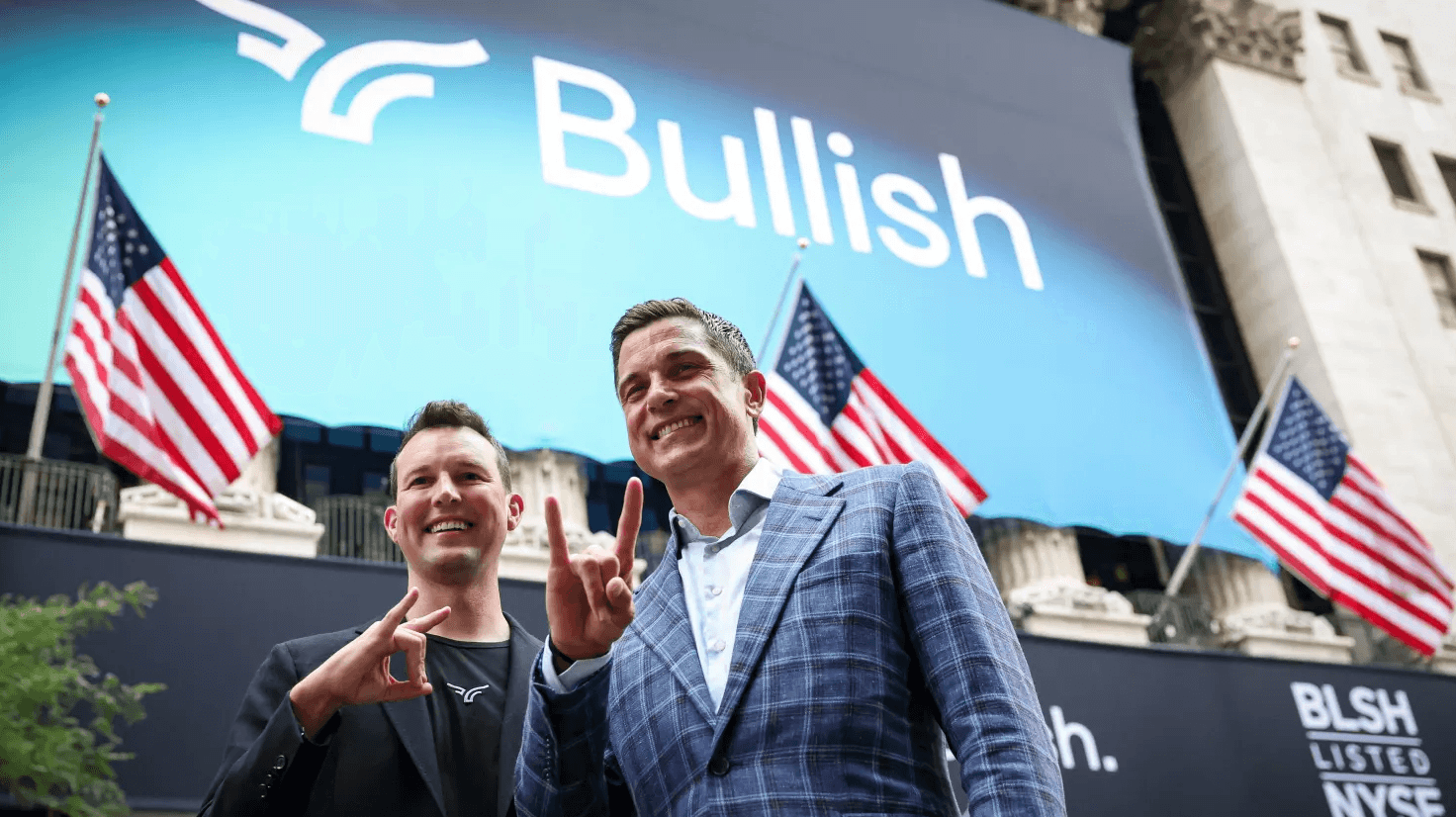
Brendan Blumer, Chairman of Bullish, and Tom Farley, CEO of Bullish at the IPO of Bullish at the New York Stock Exchange (NYSE) on August 13, 2025.
Why does it matter when crypto companies go public?
Public companies have to follow strict reporting and disclosure rules, including filing regular financial reports with the SEC that anyone can read for free. When a crypto company goes public, it follows the same rules as any other listed company, which gives people a clearer look at how the business is run.
Going public also means everyday Americans can buy shares of these companies through the same brokerage accounts they already use for other stocks. Keep in mind that owning shares in a crypto company is not the same as owning crypto itself.
Interest in regulated ways to engage with crypto shows up at the bank, too. According to NCA’s 2026 Crypto at the Bank Report, nearly a quarter (22%) of U.S. adults would like to access crypto ETFs or funds directly through their bank. And while many customers say their banks aren’t bringing up crypto, when they do discuss it, they are nearly four times as likely to recommend crypto than to advise against it.
Where to learn more
As crypto and traditional finance continue to overlap, NCA will keep breaking down what these changes mean for you in accessible language.
You can start with crypto basics in NCA’s Learning Portal.