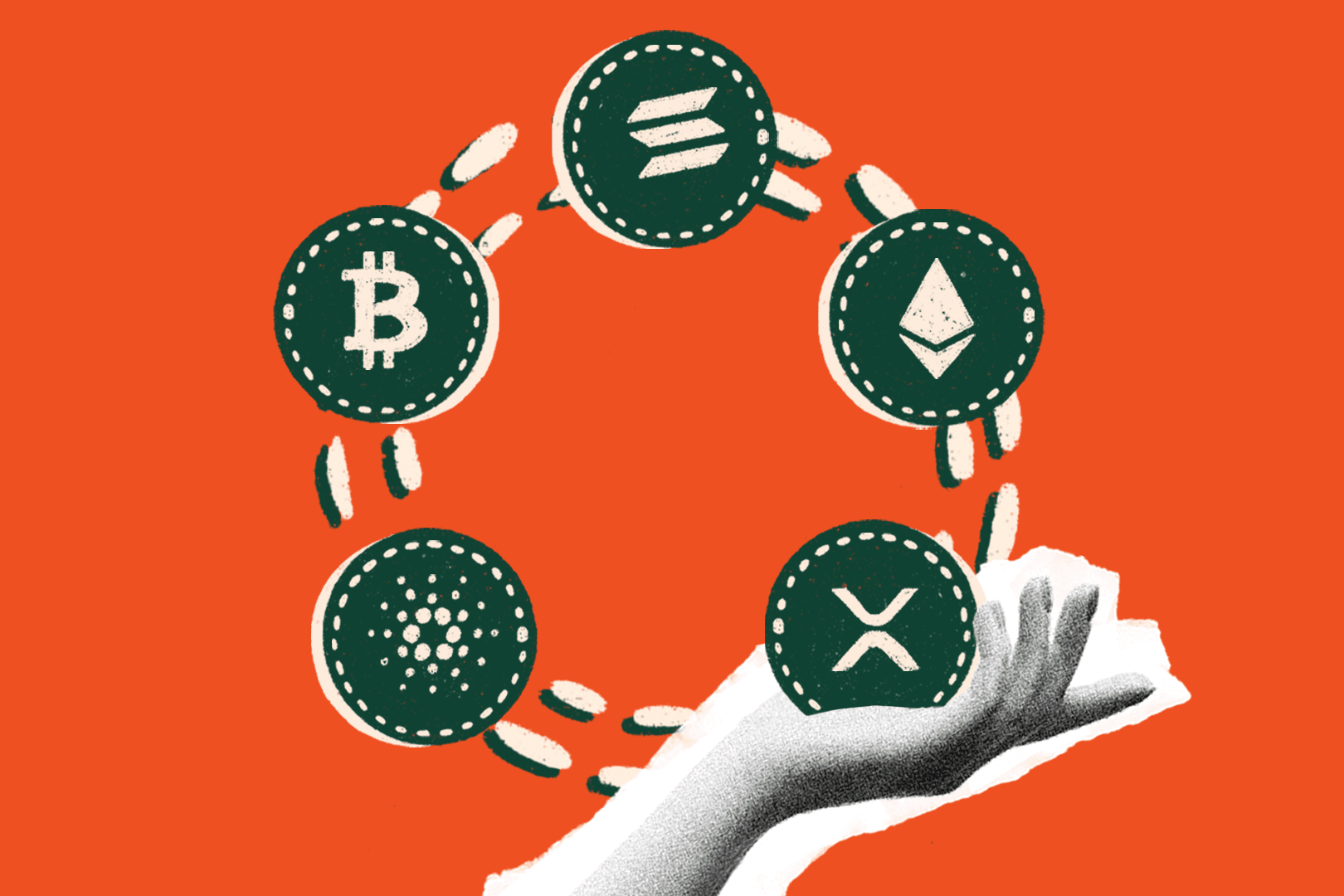
People often talk about cryptocurrencies as if they are all the same thing. Bitcoin, XRP, Ethereum. They’re all just “crypto,” right?
No, actually. Calling all tokens and coins the same is like saying a savings account and a debit card are identical because they both involve money. They’re related, sure, but they’re built for different purposes.
Each major coin has its own blockchain, which is the underlying technology that records transactions and keeps the system running. Each blockchain has a native coin, the currency that powers that network. Bitcoin’s native coin is BTC. The XRP Ledger’s is XRP. Think of the blockchain as the highway and the coin as the car moving on it.
One important technical distinction: a coin is a cryptocurrency that runs on its own blockchain (like BTC on Bitcoin or XRP on the XRP Ledger), while a token is a cryptocurrency built on top of an already existing blockchain. For example, many popular tokens run on the Ethereum network - including but not limited to its native coin ETH. You’ll see both terms come up as you explore crypto, and I wouldn’t get too hung up on the difference since most people end up using the terms interchangeably.
With that in mind, here are five major networks and what makes each one useful.
1. Bitcoin (coin = BTC)
Bitcoin is the original cryptocurrency and is still the most well known. Its main purpose is straightforward: to serve as a long-term store of value. People often call it “digital gold.” Like gold, Bitcoin has a limited supply: there will only ever be 21 million BTC. No government or company can print more of it, which is part of what gives it value in the eyes of the people who hold it.
People use Bitcoin to store value over the long term without relying on a bank, to transfer value directly to another person without a middleman, and to hold an asset that can’t be controlled by a central authority.
Bitcoin’s blockchain wasn’t designed to run apps. Its strength is durability and security.
2. XRP Ledger (coin = XRP)
If Bitcoin is about holding value, the XRP Ledger (XRPL) is about moving it. The XRPL and its native coin, XRP, were designed for speed and efficiency, particularly for cross-border payments. Transactions on the XRPL typically finalize in three to five seconds with minimal fees.
That speed matters. Sending money internationally through traditional banks can take days and involve multiple intermediaries, each adding cost and delay. XRP serves as a bridge between currencies, enabling quick conversions without routing through a chain of banks.
Banks and payment providers have adopted XRP for this reason. It’s built for institutions that need reliable, fast payment rails, but it’s also available to anyone who wants to move value quickly and affordably.
3. Ethereum (coin = ETH)
The Ethereum network introduced smart contracts, , which are programs that run automatically on the blockchain when certain conditions are met.
Ethereum powers decentralized finance (DeFi) tools for borrowing, lending, and trading. It hosts NFTs for digital art, event tickets, and identity verification. It supports DAOs (Decentralized Autonomous Organizations), which are communities that govern themselves through code instead of a traditional board of directors. It operates gaming platforms, virtual worlds, and Layer-2 networks that help manage traffic on the main blockchain.
People sometimes call Ethereum “the world’s programmable blockchain.” It’s the foundation for thousands of decentralized applications (dApps), which run on a blockchain rather than on a single company’s server. Its native coin, ETH, is used by users to interact with these applications and keep the network running.
4. Solana (coin = SOL)
Solana is a smart-contract blockchain, similar to Ethereum in concept, but built with a focus on speed and low transaction costs. While Ethereum sometimes becomes congested during periods of heavy use, Solana was designed to handle high transaction volumes without slowing down. Its native coin, SOL, is used to pay for transactions and to secure the network through staking.
That performance makes Solana a popular home for consumer-facing crypto apps. It’s where you’ll find a growing number of memecoin communities, NFT marketplaces, gaming projects, and newer tools for payments and social platforms. If Ethereum is the established city with deep infrastructure, Solana is the fast-growing suburb that’s attracting builders who want room to move quickly.
5. Cardano (coin = ADA)
Cardano takes a slower, more deliberate approach to building its network. Changes are developed through academic research and peer review. Developers and researchers in the Cardano community can propose changes by publishing formal research papers. Other independent academics and developers then review and test those proposals before anything goes live. Think the way peer review happens in science or medicine. Outside experts check the work before it's approved. The goal is to get things right the first time. Its native coin, ADA, powers transactions and staking on the network.
Cardano explores real-world use cases beyond finance. Projects on the network explore identity verification tools for government services (think proving your identity to access public programs, renewing credentials, or verifying records across agencies) and financial infrastructure for communities where traditional banking is limited or unavailable.
Key Takeaways
Each of these five networks serve a different role.
Bitcoin is built for long-term savings.
The XRP Ledger is built for fast, affordable transfers.
Ethereum is a platform for programmable applications.
Solana prioritizes speed and low cost for everyday users.
Cardano takes a research-first approach to building reliable, sustainable systems.
Together, they show that crypto is not a single product or experience. It’s a growing set of tools, each designed for a different purpose. Whether you want to save for the long term, send money across borders in seconds, explore new kinds of apps and digital ownership, or support infrastructure that expands access to financial services, there’s a network built for that.